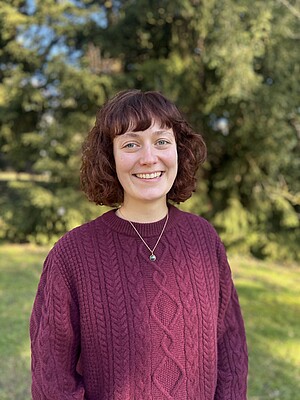
Doctoral candidate
Landscape-scale effects of pesticides on biodiversity and ecosystem services
Tel: +49 (0)711 / 459-23602
e-mail: isabell.braunstein@uni-hohenheim.de
Research project
As part of my PhD project (2026–2028), I investigate how the use of synthetic chemical pesticides affects biodiversity in agricultural landscapes. While the effects of pesticides have often been studied at the individual field scale, much less is known about how different levels of pesticide exposure across entire landscapes influence insects, birds, and bats. The aim of my research is therefore to improve our understanding of both the direct and indirect effects of pesticides on different groups of organisms and the ecological functions they provide.
My project is conducted across 20 agricultural landscapes in Baden-Württemberg, Germany, which differ in their management practices and levels of pesticide use. Within these landscapes, I survey flying insects using Malaise traps and monitor the activity of birds and bats with passive acoustic recorders (AudioMoths). In addition, pesticide residues are analyzed, while habitat structure and food resource availability are assessed at each study site. Insects are evaluated in terms of biomass, abundance, and species richness, whereas bird and bat communities are assessed based on their activity and diversity.
By integrating biodiversity data with information on landscape structure and pesticide exposure, I aim to determine how reducing pesticide use may affect biodiversity and key ecosystem services. Particular emphasis is placed on pollination, natural pest control, and the ecological resilience of agricultural landscapes.
The central research question is:
How does exposure to synthetic chemical pesticides affect biodiversity and ecosystem services at the landscape scale, and what potential does reducing pesticide use offer for conserving biodiversity in agricultural landscapes?
Short CV
I began my studies in Agricultural Biology at the University of Hohenheim with a strong interest in plant physiology. During my bachelor's thesis, I conducted fundamental research on interactions between parasitic plants and their hosts. Specifically, I investigated the characterization of a protein expressed during the infection of the host plant Arabidopsis thaliana by the hemiparasitic plant Phteirospermum japonicum.
During my subsequent master's studies, my research interests gradually shifted from molecular biological processes at the organismal level toward ecological questions at the population and landscape scales. I therefore specialized in agricultural and landscape ecology. In my master's thesis, I investigated the effects of land-use change on the management-dependent fen plant community Primulo–Schoenetum ferruginei. To do so, I compared historical vegetation surveys and land-use records with newly collected field data from the Federsee region and the Bad Wurzach Marsh, enabling me to assess changes in vegetation composition and plant community structure over time.